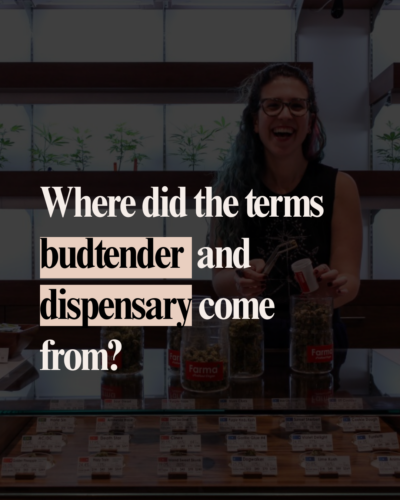
Today, when most people hear the terms “budtender” and “dispensary,” they know they refer to a retail cannabis store and the people who work in them. What you might not know is where the terms came from and why we use them.
Although the school was formally established in 2007, Oaksterdam’s founders opened some of the world’s first cannabis retail storefronts in the mid 1990s in downtown Oakland—before California legalized medical use in 1996.
Jeff Jones launched the Oakland Cannabis Buyers’ Cooperative (OCBC) in 1995 as a bike-delivery service and converted it into a storefront on July 4, 1996. In November, California voters passed Proposition 215, legalizing medical marijuana and igniting the national movement towards cannabis law reform. At OCBC, Jeff and his team considered themselves “therapeutic counselors” because when they provided patients with cannabis, they found that they also needed to provide a lot of guidance.
“We would completely unveil what cannabis could be for patients — edibles, pills, flowers, vaporizing. We guided them to the solution that fit their needs.”
Jeff says the terms “budtender” and “dispensary” originated in conversations with Oaksterdam University’s other co-founder, Richard Lee, about how distribution was evolving in the semi-legal California market.
“Richard really liked the idea of making [dispensaries] like a bar and calling it a ‘bud bar,’” Jeff recalls. “I always described it more like a dispensary—a medical office where patients received medicine based on their doctor’s recommendation.”
Both Jeff and Richard’s terminology stuck, and today the budtender fills the same critical void for consumers by helping them navigate cannabis sold in dispensaries.
“A budtender in the past was both an interpreter and a guidance counselor. They needed to interpret the patient’s problem and then guide them into their solution,” Jeff says. “Today, it is not much different, but budtenders also have the opportunity to advocate as new policies are shaped. Budtenders get to talk to the public and give feedback to public officials that could, long-term, actually push these issues in a more legitimate fashion because they are the ones on the front line.”
Jeff is right. Budtenders are still the most influential people in cannabis because they interact with consumers every day. Because of their outsized role in the supply chain, it is vital that budtenders know how to provide real, meaningful product guidance without making things up or becoming a liability by dispensing unqualified medical advice.
Oaksterdam University trained the world’s first budtenders, and we continue to train the world’s best. We train everyone from entry-level budtenders to retail managers and owners. Train your team, or become an Oaksterdam-certified budtender today.
You’ll learn:
- The history of the cannabis plant and the evolution of current laws and regulations
- Federal Prohibition and the interaction with state, Tribal, and local governments
- The roles and responsibilities of a dispensary worker
- How to navigate product claims and certificates of analysis
- Cannabinoids, terpenes, and other cannabis constituents
- How to talk about dosage, methods of ingestion, and cultivars
- How to provide meaningful product guidance
- How to increase dispensary sales and customer satisfaction
Become an Oaksterdam-certified Budtender today! We also have state-specific budtender training programs available in California, Connecticut, Michigan, Minnesota, Mississippi, New Jersey, and Utah. Interested in bulk or business pricing? Contact support@oaksterdamuniversity.com so we can customize a training plan for you.
Want to learn in person? Join us in Kansas City, Missouri, alongside the MJ Unpacked Conference on October 13!