

High Times Magazine recently released an article How Genomics is Shaping the Future of Cannabis Genetics by Oaksterdam’s Director of Academics, Angela Bacca. We conducted many in-depth interviews with experts on cannabis genomics and genetics, which are fascinating reads in their own right that we wanted to share. Below is a Q&A with Dale Hunt, PhD, JD, a plant biologist and patent attorney, about cannabis genomics and how the industry is shaped by business and patenting.
Angela Bacca (AB): When I first met you, we identified that we both have strong ties to Utah, Utah’s medical cannabis movement, and Mormonism. We also both volunteered our time to support the patient advocates working to pass the ballot initiative for medical cannabis there in 2018. As I was outlining this article and thinking about conversations we have had about plant genetics and genomics, and the super-interesting history of Utah genealogy—which includes a lot of polygamy in many family trees—I was wondering if there is a connection or parallel that can be drawn between cannabis genetics and human genetics in Utah. Whereas many people can trace their genetics to many of the same males in Utah, many, many, many cannabis genetics can be traced to a small number of the same females. Is this a fair comparison? How does it affect the genetics of modern cannabis to trace back so many cultivars to the same mothers?
Dale Hunt (DH): Yes, I feel a nice new kinship with cannabis. I do think there is something to that. You’ve probably heard of the genetic term “the founder effect.”
AB: No.
DH: Okay. Let’s take the extreme version of the founder effect, which also ties back to religion. If the [biblical] flood had really happened, if there really had been a Noah and an ark with two of every animal, that would mean that, however long ago that was, there was a narrowing of genetic variability down to eight human beings and two of every animal. And, when you have that narrowing of genetic variability, then you know the subsequent population is limited. It can only be the genes that were passed on that were present in those founders, in those ancestors, with a relatively slow rate of mutation of new genes arising.
So yes, I think there is a founder effect in cannabis because, as you’ve noted, there were a limited number of moms that were bred, and there was also a lot of selection for high THC-producing plants, at least in the last century or so. Presumably, what we get in commercial cannabis is an extremely narrow slice of the overall genetic variability that must be out there from millions of years of evolution of the species.
There is a founder effect in cannabis because, as you’ve noted, there were a limited number of moms that were bred, and there was also a lot of selection for high THC-producing plants, at least in the last century or so. Presumably, what we get in commercial cannabis is an extremely narrow slice of the overall genetic variability that must be out there from millions of years of evolution of the species.

A depiction of the genetic founder’s effect. SOURCE: Wayground.com
AB: Why is the founder effect called the founder effect?
Let’s say you have a wagon train crossing the plains, and it ends up in Salt Lake City. Maybe there are 2,000 people there, whereas there might have been about 10 million people where they came from on the East Coast. The genetic diversity of those 2,000 people is likely to be much less than that of the 10 million people they left behind. If you counted up all of the forms of all the genes in that founder pool, that gene pool of the small population of founders is the upper limit to the diversity that you can produce in the offspring. The smaller the number of founders, the more pronounced the effect is.
The smaller the number of founders, the more pronounced the effect is.
In the case of the Mormons, you have a fairly racially homogenous group mostly derived from people in the Northeast US and immigrants from England and Scandinavia, so it is true that you see people in Utah who often look alike. That is probably the result of the founder’s effect.
AB: But polygamy too, right?
DH: Polygamy and inbreeding.
AB: Ok, and to bring that back to cannabis, I am thinking there must be a huge founder effect there, right? There are some pretty prominent landraces that made it to Amsterdam and the West Coast of North America that really are the ancestors of everything. Then there was a ton of cloning of the mothers, so a similar founders’ effect with polygamy and inbreeding, except that many of the same mothers were bred with many fathers instead of the other way around.
DH: Exactly. It is like you’re in a small town with just 20 families in it, and even with an influx of new families, it doesn’t take very many generations until everybody is to one degree or another inbred.
AB: And Phylos Bioscience kind of proved that with the Galaxy, right? Like everything really was part OG Kush.
DH: That’s the founder effect, and it is usually encouraged by some sort of geographic isolation and a relatively small group of individuals. It’s really not uncommon, but I think Phylos probably illustrated it in cannabis. It makes perfect sense because if you think about the way breeding was done, it was a relatively small number of special varieties that people used to breed other things.
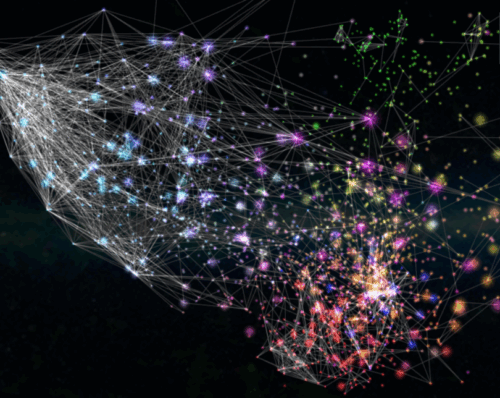
The Phylos Galaxy displayed the relationship between individual genetically sequenced cannabis cultivars (represented by the stars) and the relationships between them (represented by the constellations). PHOTO SOURCE: Friendly Aussie Buds
AB: One of the things we like to talk about in the cannabis industry is how much more genetic diversity there is compared to bigger crops like corn or soy. Or, for example, bananas, how only a couple of cloned cultivars make up the entirety of mass production. Is cannabis really that genetically diverse or, is this just a story we are telling ourselves?
DH: Well, if you look at something like grain corn, there probably isn’t a lot of diversity there. I am sure they are always breeding varieties that will result in incremental improvements over existing corn, but there are a certain handful of traits that would make grain corn desirable, and if everyone is breeding for these same traits, you would still have relatively little diversity.
With cannabis there will always be more diversity because we’re asking the plant to do more things. The plant is bred and used for fiber, seed, and flower, but within the flower category, there is a lot of breeding for chemotypes. It is the same plant genus that is answering a lot of the commercial needs and opportunities, so that diversity of uses creates a floor of how much uniformity there may be genetically, because you know you aren’t going to be able to address a lot of the different uses of cannabis without more diversity.
AB: Right, because corn is mass-produced for fewer uses: maybe as a food additive (like corn syrup) or ethanol. So, you really only need a couple of high-performing cultivars for that type of market structure. But I know in places like Central and South America, there are a ton more corn varieties that aren’t in mass production.
DH: Right, it’s the difference between natural selection versus intense agricultural selection. Natural selection can produce a lot of diversity. Genetic diversity and genetic novelty is kind of the fuel of natural selection. In the case of corn, there is intense human selection for specific traits. So, it’s not as if we are trying to avoid any kind of novelty but we are also not doing anything intentional to promote diversity.
It’s the same with bananas. If you are defining diversity by the total number of bananas in the world, almost all of which are commercially produced, the small fraction of bananas out there that aren’t commercially produced would have a lot of variability. But, as the proportion of the overall banana population, this diversity is only in a tiny fraction of the world’s bananas. It’s the same thing with corn.
With cannabis there will always be more diversity because we’re asking the plant to do more things.
AB: Regarding defining genetic diversity in a plant population, I have seen many articles recently about how legalization is narrowing the cannabis genetic pool and that the genetics are becoming less diverse as a result because of market demands for specific varieties. With corn and bananas, if the business model isn’t incentivizing people to grow other varieties, are they still being grown, at least in small batches, if not in a significant way to affect the gene pool now? And with cannabis, the diversity we have compared with bananas and corn was influenced by the Prohibition business model, which resulted in a larger number of smaller growers and breeders and more varieties. That’s changing. In this context, is it really ever possible that cannabis would go the way of corn or bananas? My instinct is to say no, because that Prohibition business model has existed for nearly 90 years. So, although I and the generations before me may only know one kind of banana, it’s the opposite with cannabis. We expect variety.
DH: Even if it does [move in the direction of bananas], that won’t be the only demand. Like, if we had more corn connoisseurs, we would probably have more diversity in commercial corn. Last year, I was invited to attend an indigenous corn conference in New Mexico, and there were so many different kinds of corn people were cultivating in smaller areas as a way of preserving their heritage and the corn genetics. It was really impressive how many different kinds of corn there are.
The thing is, with plants that can grow truly in the wild and do their own thing without a lot of human intervention, a lot of genetic diversity will be preserved in the absence of habitat loss. Of course, habitat loss is another driver that is limiting biodiversity all over the place. Diversity or lack of it depends on how broadly you define it, because if it is the total number of plants in the world and how much variability there is on average, you will see that almost everything represented in that population is going to be agricultural and therefore very limited in its diversity.
But I think there is still a lot of genetic diversity out there; it’s just that we don’t think of it that way. There are real drawbacks to monoculture that are economically overcome by the benefits of monoculture. But the real reason there will never be as much of a lack of diversity in cultivated cannabis is that we ask the plant to do so many more things.
There are real drawbacks to monoculture that are economically overcome by the benefits of monoculture.
It may be the case that there are varieties of corn that produce molecules that are medicinal or others that could produce amazing fiber, but it’s just that we locked in on what we want corn to do.

A bunch of cloned Cavendish bananas. SOURCE: Giorgio Trovato via Unsplash.com
AB: There are actually medicinal compounds in bananas, some of which have mechanisms of action similar to immunosuppressant drugs prescribed to people with autoimmune diseases. It’s not that eating a banana will cure autoimmune disease, but it’s not going to exacerbate it either, and probably does support immune response in a more complex way. And I think what’s interesting about cannabis in this context is it highlights how much we really don’t know about what so many other plants can do because we have never examined them the way we are examining cannabis right now.
DH: I agree with that. I had an undergrad professor who was an ethnobotanist who did quite a bit of sampling of unknown plants in the rainforest because he was looking for medicines. He was a pharmaceutical ethnobotanist looking for a wonder drug that the pharmaceutical industry would fall in love with. It is not to say that that’s the right way to mine genetic diversity, but it was what he was doing in the 1970s and 80s.
Plants are biochemical factories, and they produce these biochemicals to defend themselves, communicate, and reproduce. They have a different approach because, unlike animals, they can’t move around, so they developed better chemical defenses. So yeah, we haven’t even scratched the surface of what plant biochemistry can do. But if we have a plant that has been the most studied, maybe not in an academic context but in the context of people looking for all the things it can do, it is probably cannabis.
If we have a plant that has been the most studied, maybe not in an academic context but in the context of people looking for all the things it can do, it is probably cannabis.
AB: With your background patenting other plants, is it easier to make sense of and patent other plants, or is cannabis unique in that sense, in that it’s just such a mess of a family tree?
DH: I’ve done quite a bit with grape genetics, and it’s interesting when you look at grape genetics because this is probably the case with a lot of different agricultural species that have been heavily bred. Most of them have a founder effect because the breeders either start with a relatively limited pool of breeding stock, or they go and select the breeding stock because it is extra hardy, or because it is highly productive or disease resistant. They’re not randomly sampling from the world of grape genetics. They’re going out and picking things that a lot of people might find desirable, and they might end up making the same choices. What that means is that if you sequence a commercial variety of table grape, very much like you might see with cannabis, maybe on a different scale, but very much like it, you’re going to see genetic similarities among different commercial varieties that are not random. That doesn’t necessarily mean that one was used to breed the other or that one infringes the other from an intellectual property point of view. It might just mean there’s a founder effect that they came from a relatively skewed segment, a relatively small sample of the overall diversity in the grape genome. I think that’s probably common in most crops unless there’s been a conscious effort to go out and get diversity and maintain diversity. There is naturally a convergence of starting materials or breeding objectives.
I haven’t seen any greater difficulty with cannabis in IP protection than with other varieties, except that there are two ways that it’s harder. One is a lot of patent examiners, when they pick up a cannabis application, it’s the first time they have [worked on a cannabis patent applicant] and they don’t have as well-established protocols for examining them. So, sometimes an examiner is going to give you some really unusual requirements or ask for some unusual information.
If, say, I am trying to patent a blueberry cultivar, there is a lot less variability in the way they’re examined and most examiners have worked with blueberries before, so they know what they’re looking for. In that way, to the extent that an examiner is handling a cannabis application for the first time and they’re used to something like corn or soybeans, they might have unrealistic expectations about what you can tell them. They definitely have unrealistic expectations about how variable the accumulation of cannabinoids and terpenes is, so they make some wrong inferences in that way.
The other way that it’s harder is cannabis does have really high variability. Even if you’re growing clones, they can respond so differently to different cultivation conditions that it’s hard to see the genetic uniformity unless you know it’s there—and that’s been something that examiners have had a hard time getting their head around.
AB: I have also been wondering about tying effects to genetics. I know a lot of excitement about genetic sequencing in the cannabis industry was the idea that we could correlate specific varieties with effects. Many well-funded companies have come into the industry purporting to help consumers find varieties based on the effects they desire. As the industry has matured and there has been more genetic sequencing, I think a lot of people are finally starting to realize there is too much nuance in the cultivars themselves, the names they are sold under, and how human bodies interact with them to draw these broad correlations between genotype and effects. Do you even think this is possible?
DH: I think we would need a lot bigger sample size because, first of all, effect is so subjective. It’s reported by a user, and different user experiences can be different. As you know, the same user with the same variety of cannabis can experience a different effect depending on the method of ingestion, time of day, or other factors.
Second, I don’t think we know enough yet to know that a particular effect always comes from a particular phenotype of the plant. In other words, I might feel, depending on how precise it is, a certain kind of effect that comes from a combination of two different cannabinoids and three other terpenes, and a different combination of cannabinoids and terpenes could kind of accidentally or convergently bring the same effect.
I don’t think we know enough yet to know that a particular effect always comes from a particular phenotype of the plant.
I’m not saying it would be impossible to ever tease that out, but I think first of all, you’d need much more precise measures of the effect than we have right now and a huge sample size to be able to tease out the things that might be convergent. There are morphologies in plants that may be very similar even though they’re not closely related.
AB: Can patenting actually preserve genetic diversity, and can it also eliminate it?
DH: I don’t think patenting necessarily limits diversity, but I would say it correlates with business purposes that don’t necessarily place a high value on diversity. You know, when you’re patenting a plant, it’s because you’re likely to produce it in large quantities. And especially if it’s a traditional US plant patent, which is a clone patent, then basically, by definition, you’re going to be having a monoculture of that particular variety wherever you’re growing it. I don’t think patenting should necessarily be considered a cause of that [monoculturing]. I think it’s more like an indicator, or just a correlative activity that comes from the commercial objectives that would drive you to cultivate large amounts of the same thing.
AB: From your vantage point, what do you think the future of cannabis genetics is going to look like?
DH: That’s a good question, I think, because we still don’t know. There’s so much we don’t know about possible beneficial effects or just commercial appeal—whether it’s for adult use or medicinal use. There’s so much we don’t know about cannabinoids, terpenes and other products and combinations, as well as traits that are going to matter, like disease resistance or elasticity under cultivation conditions, or consistency under different cultivation conditions.
If we get better at correlating sequences with traits, we might actually see a drive, some real value in going out and pulling in more genetic diversity, for intentional breeding. If we are starting with the kind of founder effect that I talked about at first, we’re limited by that founder effect in what we can produce, and it might be that we’ve got the tools to produce a lot of great things, but there are probably some genetic tools out there that we haven’t tapped into that we could. And so if somebody had a lot of money to throw at this or had a lot of computing power and a lot of sequencing power and and some knowledge about what the sequences would produce in terms of traits, I do think that there could be a a real mining of diverse genetics, landraces, and more to find more diversity for a breeding pool to produce more things.
Want to learn more about cannabis genetics, genomics, and breeding? Check out our new Cannabis Breeding with James Loud certification program, which includes seven self-paced modules with course videos and an extensive collection of supplemental resources. There is also another opportunity to join live classes in April 2026!