
by Greg Borstelmann
One of the biggest misconceptions about tissue culture success is that it depends on expensive equipment. Many new labs assume that if they spare no expense, success will follow. I understand the thinking. You bought the fastest car money could buy, so you should win the race. But the fastest car means nothing if you don’t know how to drive it. Let’s dive into how to set up a successful tissue culture operation on a budget.
Equipment Doesn’t Create a Program
A laminar-flow hood with glass panes and UV lights doesn’t guarantee sterile technique.
A large autoclave doesn’t create optimized media.
A dedicated room doesn’t automatically create good workflow.
I’ve seen expensive labs struggle to stay afloat while modest setups perform consistently well, and the difference is rarely budget. It’s understanding what drives growth in vitro and the discipline to follow proper SOPs day in and day out.
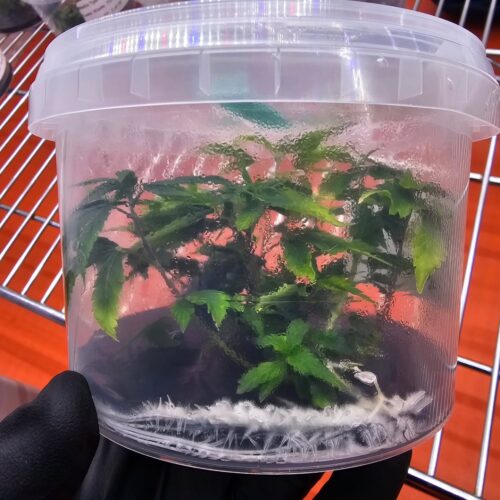
Plants growing in culture. Photo: Greg Borstelmann
A tissue culture lab is a system.
Facility design, workflow, technician habits, documentation, and training matter just as much as the equipment itself. When those pieces don’t align, no amount of equipment can compensate.
Small Labs vs. Large Labs
Interestingly, new and established labs struggle for the same reason, just in different ways.
New labs tend to change too many variables at once. When something goes wrong, everything gets adjusted—media, hormones, lighting, technique—which makes it nearly impossible to identify what actually caused the issue.
Established labs struggle when scaling. Protocols that worked at low volume are assumed to work at high throughput without verification. Different problems. Same root cause. Weak documentation and feedback loops. Without clear records, problems become harder to diagnose and easier to repeat.
The Myth of the Perfect Media Recipe
Another common mistake is copying media recipes from blogs or papers without understanding why they work.

Tissue culture plants growing in soil. Photo: Greg Borstelmann
In cannabis tissue culture, there is no universal “perfect” formulation. What works for one cultivar may stall another completely. When I train technicians, I encourage a controlled “shotgun” approach during R&D, testing structured variations across cultivars using the media formulations we provide in our consultations and trainings. The key is controlled variation, not random adjustment.
Hormones, because they produce such drastic and visible plant responses, are often the first input technicians want to manipulate. I’ve seen many use them as blunt instruments in an attempt to beat the explants into submission, rather than treating them like precision tools to steer growth. More is not better. When observed plant reactions aren’t fully understood, frequent reformulation only creates more variables and more confusion.
The labs that succeed make fewer changes, track results carefully, and adjust only when there is a clear reason to do so.
Success is Accessible
The good news? You don’t need a massive budget to run a successful lab.
Smaller labs can often outperform expensive ones because they focus on these key factors:
- Consistency
- Documentation
- Controlled changes
- Intentional workflow
Success in tissue culture isn’t bought. It’s built.
Greg Borstelmann is the founder of Shoots n’ Roots, a leading cannabis tissue culture consulting company. He has helped cultivators across the U.S. establish clean plant programs and commercial-scale labs using optimized, research-backed micropropagation systems.